
Reviewed · 2-DAY EXPERIENCES
2 Days Private Bataan Tour with Corregidor
The road remembers everything. This two-day private tour links Bataan Death March memorials with Corregidor Island, giving you a serious look at the Second World War in the Philippines. I like the private car and guide, which let you shape the day around your interests, and I like the focus on real places rather than a quick run through a museum. The main drawback is the price: at $1,150 per person, this is a major splurge.
You should also expect early starts and long, emotionally heavy days. The tour suits a history-minded visitor far better than someone looking for a light sightseeing outing. Still, the chance to visit the route of the Death March, Camp O’Donnell, Mount Samat, and Corregidor in one carefully planned trip is unusual.
In This Review
- Key points before you book
- Why this Bataan and Corregidor trip matters
- Day one begins at Capas National Shrine
- Bamban Museum brings the war down to objects
- The Bataan World War II Museum marks surrender
- The Zero Kilometer marker sets the route in motion
- Corregidor requires an early second morning
- Mount Samat gives Bataan its final battlefield
- San Fernando completes the prisoner story
- The private guide is the heart of the experience
- Is $1,150 per person fair value?
- Practical details that can shape your decision
- Who should book this tour?
- FAQ
- Where does the tour start?
- How long does the experience last?
- Is this a private tour?
- How long is the boat ride to Corregidor?
- How much time is spent on Corregidor Island?
- Are admission tickets included?
- What happens if bad weather cancels the tour?
Key points before you book
- Camp O’Donnell and the Death March route: Visit Capas National Shrine, the former POW camp, then trace the story back to the Zero Kilometer marker in Bataan.
- A private guide-led experience: Your group travels by private car with a guide and driver, making it easier to ask questions or request particular sites.
- Corregidor gets a full day: The island portion lasts about seven hours, including the 20-minute boat ride and a bus tour around the former military stronghold.
- Two useful museum stops: Bamban Museum of History is a private collection of Second World War artifacts, while the Bataan World War II Museum marks the surrender of General Edward King.
- A strong choice for family connections: One person described traveling the Death March route because a grandfather had walked it. That personal link captures the emotional weight of this trip.
- Plan around the 7 a.m. start: The early departure matters, especially because Corregidor requires a 7 a.m. pier arrival on the second day.
Why this Bataan and Corregidor trip matters
Many Manila excursions focus on beaches, food, and Spanish colonial sights. This one takes you into a harder part of Philippine history: the 1942 defeat of American and Filipino forces, the treatment of prisoners of war, and the battles that followed.
The tour is useful because it connects places that are often visited separately. You do not only see a memorial or read a plaque. You move between the surrender site, the march route, the prison camp, the final battle area, and Corregidor, where the wider campaign can be discussed in the places where it happened.
I also like the private format. With only your group taking part, you are not tied to the questions or pace of a large coach party. The guide can spend more time on military details, family stories, or the particular events that interest you.
That flexibility has real value for serious history students. It also helps if you have a relative connected to the war. One of the strongest accounts came from someone whose grandfather had walked the Death March. Following that route gave the visit a personal force that no general city tour could provide.
The cost is the hard part. At $1,150 per person, you are paying for a private two-day arrangement rather than a basic shared excursion. The value depends on how much you care about the subject and how much you value private transport, a dedicated guide, and the ability to ask for specific stops.
More Corregidor Island trips:
- Full-Day Tour in Corregidor and Bataan War Memorial from Manila
★ 4.5 · 17 reviews - Corregidor daytour Via Manila to Bataan
★ 5.0 · 5 reviews - Manila: Corregidor Island Guided Tour w/Hotel Pick up & Drop
★ 4.2 · 4 reviews
Day one begins at Capas National Shrine
Capas National Shrine, also known as Camp O’Donnell, is the first major stop. The site was formerly a concentration camp for Filipino and American prisoners of war after the Battle of Bataan.
You have about an hour here, with admission included. That is enough time for a focused visit, though the site is not the sort of place to rush through while checking off photographs. The importance comes from understanding what happened to prisoners after the surrender, when the Death March was followed by confinement, hunger, disease, and harsh treatment.
Your guide should be especially helpful here, since the meaning of the memorial depends on the sequence of events. The stop makes more sense after you understand that surrender did not end the suffering. For many people, Camp O’Donnell is where the military story becomes a human story.
Keep your expectations grounded. This is a memorial visit, not an entertainment attraction, and the mood is solemn. If you want extensive time for reflection, tell the guide early in the day. The one-hour schedule gives structure, but a private tour may offer more room for discussion if timing allows.
Bamban Museum brings the war down to objects
The Bamban Museum of History is a private Second World War museum run by a war historian. You have about an hour to see its extensive collection of wartime artifacts, and admission is free, with donations appreciated.
This stop adds a different layer to the day. Memorials give you place and memory. Artifacts give the conflict a physical presence. The museum can help you connect broad military movements with the equipment, documents, and personal material left behind.
Because it is a private museum, the experience may feel more personal than a formal national institution. That can be a strength for someone who wants direct conversation about specific objects. It can also mean the visit is best approached with curiosity rather than the expectation of a polished, large-scale museum presentation.
I would bring questions. Ask how particular objects relate to Bataan, the Death March, or the fighting in the area. The guide’s battlefield discussion is one of the tour’s most praised features, and this is a natural place to connect those explanations to things you can see.
A donation is appreciated, so carry a little extra cash if you want to support the museum. The supplied details do not state a required amount.
The Bataan World War II Museum marks surrender
The next stop is the Bataan World War II Museum, where General Edward King surrendered to Japanese forces on April 9, 1942. The itinerary gives you an hour, and admission is included.
This site helps explain the collapse of the Bataan defense. The surrender was not simply an abstract date in a textbook. It led directly to the forced movement of Filipino and American prisoners and to the conditions remembered through the Death March.
I like the way this stop fits between Camp O’Donnell and the march marker. You first see where the military resistance ended, then learn what followed for those who surrendered. That order gives the day a clear historical thread.
The visit is likely to appeal most to people who want dates, command decisions, and battlefield context. If you prefer a broad cultural tour with only a little wartime content, an hour here may feel long. For a history buff, it may feel short.
A few more trips and experiences worth a look
- From Manila: 2-Day Buscalan Tour with Apo Whang-od
★ 3.6 · 29 reviews - Cebu: 2-Day Private Tour Moalboal and Oslob
★ 4.7 · 4 reviews - Linapacan Island Palawan 2 Days 1 Night Camping Expedition Trip
★ 5.0 · 3 reviews - 2 Days SSI Advanced Open Water Course in Boracay
★ 5.0 · 3 reviews
The Zero Kilometer marker sets the route in motion
The Zero Kilometer Death March Marker marks the starting point of the march. You have about 30 minutes here, and there is no admission charge.
This is a brief stop, but it carries unusual weight. After visiting the surrender site, you are now standing at the point where the prisoners began the forced journey. The marker turns an enormous historical event into a specific location.
I would use this time to ask the guide to explain the route and how this point relates to the other Bataan sites. The value is not in the amount of time spent there. It is in making the transition from battle history to prisoner history clear in your mind.
The first day is built around that progression: prison camp, private museum, surrender site, and march marker. It is a thoughtful sequence, although the subject matter is demanding. Leave room in your schedule for quiet rather than expecting a packed day of casual sightseeing.
Corregidor requires an early second morning
On the second day, you go to the pier at 7 a.m. for the boat to Corregidor. The crossing takes about 20 minutes, followed by a bus tour around the island. The Corregidor portion lasts about seven hours.
That early start is not a minor detail. You need to be ready at the pier at 7 a.m., so this is not a tour for sleeping late after the first day. The reward is a full island visit rather than a quick photo stop.
Corregidor is central to understanding the defense of Manila Bay and the wider war in the Philippines. The island’s importance comes through most clearly when your guide explains the battlefield while you are physically moving around it. This tour promises extensive battlefield discussions, which is a major reason to choose it over a simple transport-only visit.
The bus is useful because it lets you cover the island in a practical way. You are not expected to walk the entire area, and the long seven-hour schedule gives the visit room to breathe. Still, the day is structured around the island tour, so confirm exactly how the boat, bus, and guiding arrangements fit together before you pay.
One especially positive detail is the report of having Corregidor almost to oneself and receiving a VIP-style visit. You should not assume that same level of quiet every time, but a private group can make the island feel more personal than a large organized outing.
Mount Samat gives Bataan its final battlefield
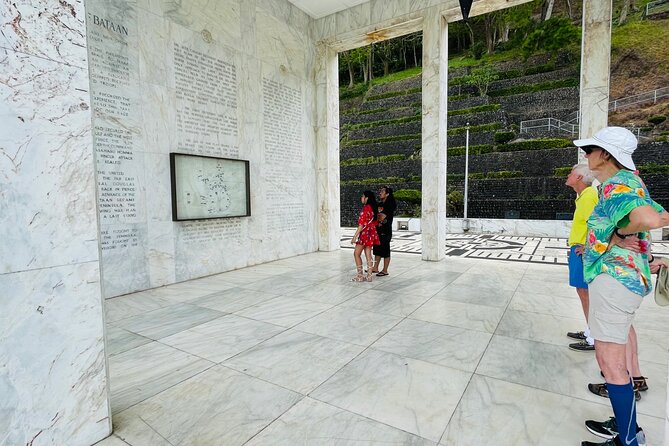
Mount Samat National Shrine, also called Dambana ng Kagitingan, is visited for about two hours. This is the mountain where the final battle of Bataan took place before the American surrender, and admission is included.
The shrine gives you a high point from which to consider the last stage of the Bataan campaign. It is not just another memorial added to the schedule. It helps explain the terrain and the military pressure that shaped the final battle.
Two hours is a useful amount of time here. You can take in the shrine, listen to the guide, and ask how the mountain fits into the broader story. I would pay close attention to the geographic explanations. Battlefield sites often make more sense when you understand why a particular ridge, road, or summit mattered.
The order shown for the second day places Corregidor before Mount Samat, with San Fernando also included. Because travel timing between these locations can be important, ask the operator to confirm the exact running order and transport plan before departure. That is a practical question, not a criticism. A private tour should give you a clear answer.
San Fernando completes the prisoner story
San Fernando is a short 30-minute stop at the train station where prisoners of war were loaded before continuing to the concentration camp.
This visit links the march to the next stage of captivity. Camp O’Donnell is where the first day begins, but San Fernando helps show how prisoners were moved toward it. Together, the two stops make the chain of events easier to understand.
Half an hour is enough for a focused explanation and a look at the site. It is not enough for a lengthy museum visit, and the information provided does not describe one. Think of San Fernando as a connecting point that gives the broader route a physical anchor.
That connection is one of the best reasons to take both days. You are not seeing isolated memorials. You are following the movement of people from surrender, to march, to rail transport, to imprisonment.
The private guide is the heart of the experience
The guide and driver are central to the value here. The arrangement uses a private car, and your group is the only group taking part. That means you can ask for deeper explanations instead of settling for a standard script.
JB is named as the guide associated with the trip, and the strongest praise centers on his warmth, battlefield knowledge, and ability to personalize the route. Another person was able to request particular sites, which is exactly the kind of flexibility I would want at this price.
The tour provider is Jb Quemado. Before departure, I would send a short note explaining your interests. You might care most about military strategy, the treatment of prisoners, family connections, or museum artifacts. Giving the guide that information should help shape the discussions.
Do not expect this to be a quiet ride with occasional commentary. The point is the battlefield conversation. If you enjoy asking questions, comparing dates, and stopping to understand why a place mattered, the private format earns its keep.
Is $1,150 per person fair value?
The listed price is $1,150 per person. That is expensive by ordinary Manila day-tour standards, but ordinary day-tour comparisons are not especially useful here.
You are buying two days, private transportation, a guide and driver, the Corregidor boat and island experience, several historical sites, and the ability to keep the trip within your own group. Some admissions are included, such as Capas National Shrine, the Bataan World War II Museum, and Mount Samat. Bamban Museum is free but welcomes donations, while Corregidor is listed with no admission charge.
The price makes the most sense for a small group with a strong interest in Philippine Second World War history. It is harder to justify if you only want a quick look at Corregidor or a general introduction to Bataan. In that case, you may be paying for far more discussion and private service than you need.
The fact that this experience is commonly reserved about 159 days ahead suggests you should not leave planning until the last minute. That figure is useful as a scheduling warning, not proof that every date sells out.
Practical details that can shape your decision
Pickup is offered, and you receive a mobile ticket. The starting time is 7 a.m., with the Corregidor day specifically requiring you to reach the pier at that hour.
Most people can take part, according to the supplied participation information. The tour requires good weather, however. If poor weather cancels the experience, you are offered another date or a full refund.
The cancellation terms are strict close to departure. Cancel at least six full days before the start for a full refund. Cancel two to six full days ahead for a 50 percent refund, and cancellation less than two full days ahead receives no refund. The local start time controls those cutoffs.
I would confirm the daily order, pickup time, boat arrangements, and any meal expectations before booking. Those details matter on a private trip with a high price, especially when two days cover several widely separated historical sites.
Who should book this tour?
I would recommend it to a serious history buff, someone tracing a family connection, or a visitor who wants more than a quick photograph at Corregidor. It is also a good fit if you value a private car, a dedicated guide, and the freedom to request particular places.
I would hesitate if you dislike early mornings, long historical discussions, memorial sites, or emotionally difficult subjects. The trip is not designed as a relaxed break from Manila. It asks you to pay attention.
Book it if Bataan and Corregidor are central reasons for your visit to the Philippines. The combination of Camp O’Donnell, the surrender site, the Death March marker, San Fernando, Mount Samat, and a full Corregidor day gives you a strong framework for understanding the campaign. Skip it if the price feels out of reach or if you only want a short island excursion.
FAQ
Where does the tour start?
The tour starts at 7 a.m. Pickup is offered.
How long does the experience last?
The tour lasts approximately two days.
Is this a private tour?
Yes. Only your group participates, and transportation is by private car with a guide and driver.
How long is the boat ride to Corregidor?
The boat ride from the pier to Corregidor takes about 20 minutes.
How much time is spent on Corregidor Island?
The Corregidor portion lasts about seven hours, including the island bus tour.
Are admission tickets included?
Admission is included at Capas National Shrine, the Bataan World War II Museum, and Mount Samat National Shrine. Bamban Museum has free admission and appreciates donations. Corregidor is listed with no admission charge.
What happens if bad weather cancels the tour?
If poor weather causes cancellation, you are offered a different date or a full refund.
Just added around Manila
- Embark on a 7-Day Banaue-Sagada Adventure of a Lifetime★ 5.0 · 3 reviews
- Philippines Intro 3 days 2 nights Tour Best of Manila and Beyond★ 5.0 · 3 reviews
- Pagsanjan Falls Adventure with Lunch and Rapids Experience★ 4.5 · 3 reviews
- Manila: Intramuros Tour ( Dark)★ 4.7 · 3 reviews
- Manila: Intramuros Heritage Tour★ 4.2 · 3 reviews
- From Manila: Philippines Private Tour Guide★ 4.1 · 3 reviews
- Discover the Real Manila with a Local Guide★ 5.0 · 3 reviews
- MANILA: HISTORICAL KALESA RIDE TOUR EXPERIENCE IN INTRAMUROS★ 4.0 · 3 reviews
2-Day Experiences, side by side.


Linapacan Island Palawan 2 Days 1 Night Camping Expedition Trip
Read the review →
2 Days SSI Advanced Open Water Course in Boracay
Read the review →Where else this one shows up